

The handful of individuals who are pushing extreme prohibitions against other Sunriver owners protecting their native plants have promoted a false narrative that owners are creating extreme “eyesores” with “excessive” fencing that violates Sunriver’s “natural setting.”

Click here … to view a slideshow of about 100 Sunriver homes where owners have used various forms of protection for the plants on their own lots. Judge for yourself whether there’s a serious problem with such uses.
NO EVIDENCE!
Despite repeated requests, not a single example has been presented by the Design Committee, SROA staff, or any SROA Board member.
NO SUNRIVER OWNER SURVEY!
Also, despite repeated requests, there has been no survey of Sunriver owners’ opinions to assess whether or not there’s significant opposition to other owners using reasonable fencing to protect their native plants.
NO RECORD OF SIGNIFICANT SUNRIVER OWNER COMPLAINTS!
The SROA General Manager has so far ignored requests to document the number of complaints received from Sunriver owners about the use of protective fencing.
He has also ignored requests to review the comments and correspondence that Sunriver owners have submitted in favor or opposed to allowing reasonable use of fencing to protect native plants.
It’s clear that the entire push for extreme prohibition against Sunriver owners protecting their own native plant landscaping is a “power play” by fewer than a dozen individuals on the Design Committee, the SROA Board, and among soe SROA managers.
Examples of misguided and counterproductive rules
A few individuals’ personal dislike of how fencing “looks” is the only reason that’s ever been identified to adopt such extreme prohibitions. And yet, the rules are so poorly thought out that they will make visual impacts worse.
1. Prohibiting green fencing and allowing black fencing is a mistake.
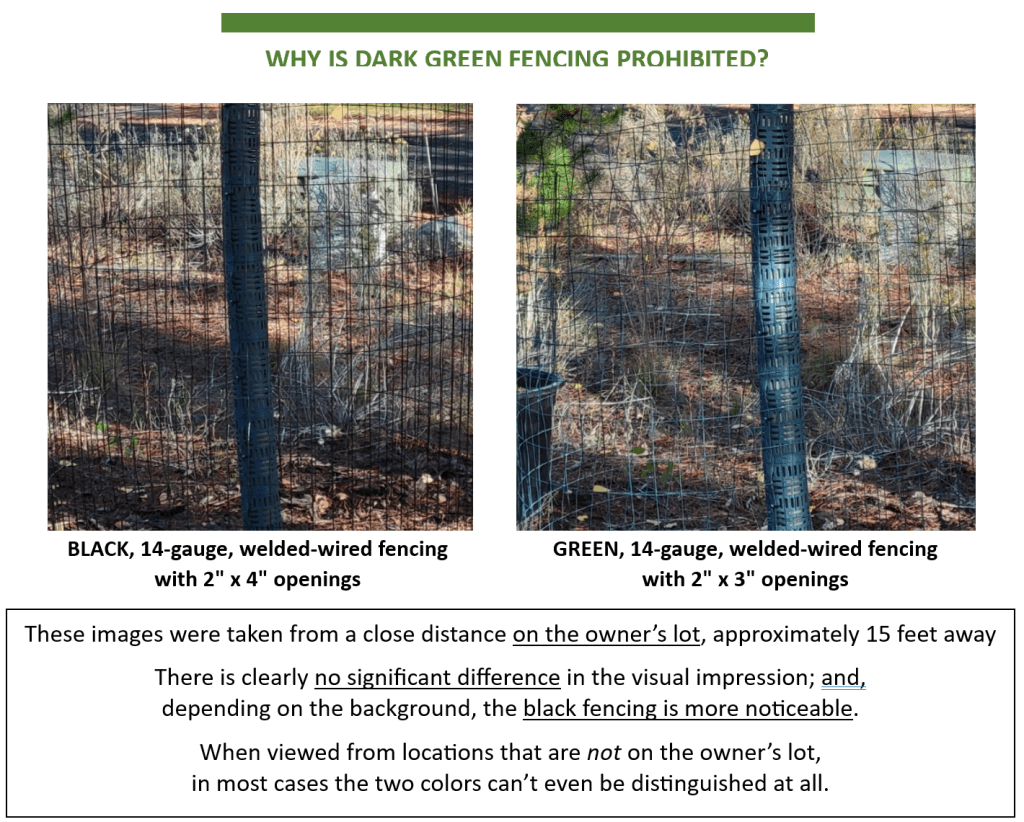
For some unexplained reason, the Design Committee’s proposed rules prohibit the use of dark green fencing, while allowing only black and galvanized.
In my survey of over 100 lots on which Sunriver homeowners are using some form of protection for their plants, I don’t recall seeing any BLACK fencing. Instead, GREEN welded-wire fencing or galvanized are ubiquitous.
There are many stores and on-line sites that sell green, welded-wire fencing with 2″ x 3″ openings in many combinations of width and length. But I couldn’t find any local store with black, welded-wire fencing of the allowed five-foot height and 2″ x 3″ opening. I finally had to special order from Home Depot, and all that was available was a 100-foot roll with 2″ x 4″ openings for over $100.00.
Since the only impact that reasonable fencing around plants has is visual, I did a simple field test. The image above shows the results.
2. Prohibiting anything but a wide column of 14-gauge fencing to protect tree trunks.
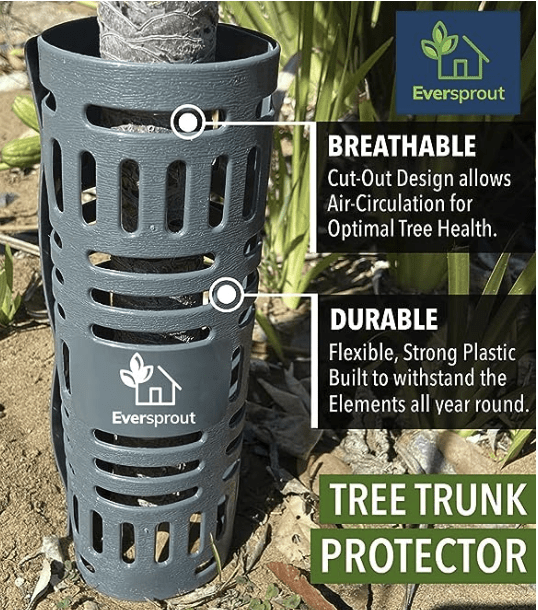
In the photos above, you can see a much better, less obtrusive “physical protection barrier” that wouldn’t be allowed under the proposed rule. This is a high-end specialized product: Eversprout Tree Trunk Protector. It requires no posts for support, is breathable and san be expanded as the trunk grows.
My survey of over 100 Sunriver lots found almost no instances of trunk protections that wouldn’t have to be removed and replaced because the means of protection isn’t 14-gauge welded-wire fencing. The proposed rule requires the entire fencing to be at least 4 inches away from the trunk. While the rule says “Staking not required,” at least one or two stakes would be required to maintain that separation.
3. Prohibiting galvanized “chicken wire” around the base of Aspen trunks is a mistake.
Note also that even though galvanized “chicken wire” that’s wrapped closely around Aspen tree trunks is almost invisible (see if you can find it in the image below), the Design Committee has prohibited that use, and Sunriver owners will have to remove all of it!
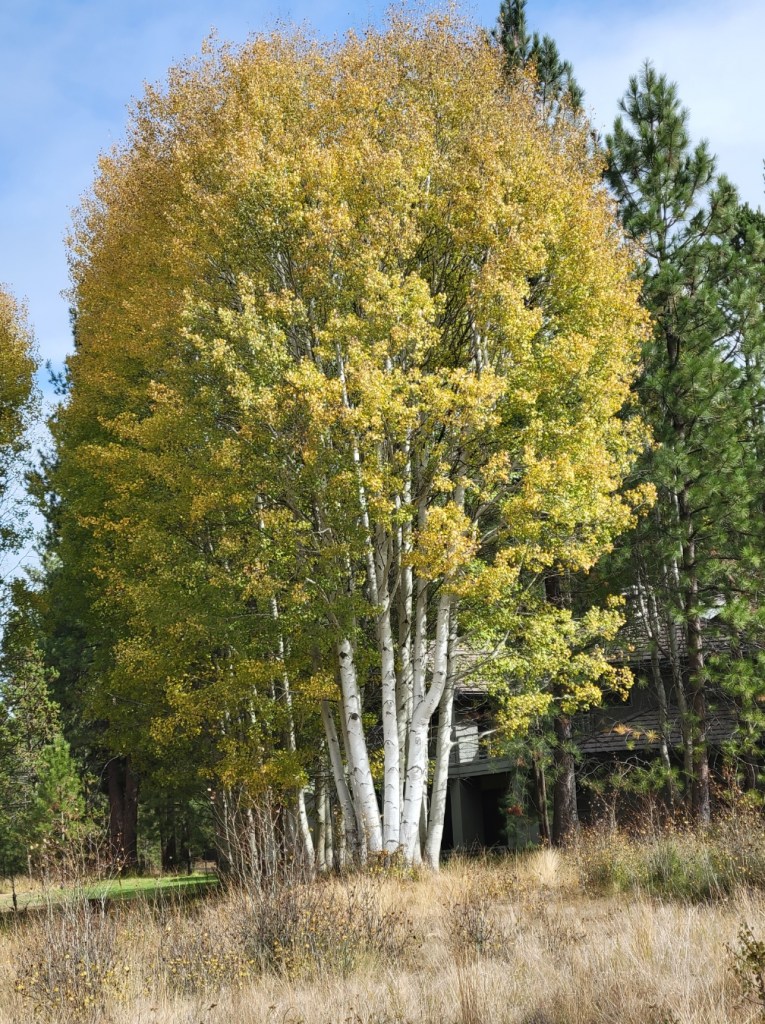
In place of this “invisible” protection, putting a black, 14-gauge fencing column that must be at least 8 inches wider than the trunk it surrounds, as well as stakes that would then be required, would be significantly more visible both in size, the presence of stakes, and the stark contrast with the white Aspen bark. (In some case of Aspen clusters, it will be physically impossible to protect all the Aspen’s trunks and conform to the proposed spacing.)
There is absolutely no reason or evidence supporting a prohibition against dark green fencing. Imposing that restriction will mean that hundreds of owners cannot even reuse their green, welded-wire fencing to conform with the proposed rules. All of that will go into the landfill!
In addition, galvanized “chicken wire” is the least visually impactful way to protect Aspen trunks and should not be prohibited.
4. A five-foot high fence that is limited to two feet from the trunk is not adequate to protect trees (and shrubs) from deer browsing.

Rather than allow higher fences, the more effective solution is to allow the fencing to be up to three feet from the trunk. That would also work for trees (and shrubs) that have wider branching structure than Aspen.
Because tree branches don’t extend to the circumference of a perfect circle, the proposed rule of a maximum diameter of four feet is unworkable. An equivalent and more flexible alternative is to specify a maximum circumference, e.g., 19 feet, which is the approximate circumference of a circle with a six foot diameter. That would allow fencing that is three feet from the trunk of a tree (or center of a shrub). In many situations, this spacing would also be effective with fencing material that was only four feet wide and set with the bottom of the fencing at six inches off the ground, thus reducing the visible fencing height and surface area.
These are just four of the numerous examples that demonstrate the Design Committee’s failure to even bother doing simple field visits and tests; and, more critically, excluding owners from any discussions about sensible rules for plant protections and the impacts that these poorly conceived rules will have.
 SUNRIVER NEIGHBORS